
Increasing News Dissatisfaction, Decreasing Trust, and Limited Data Visibility
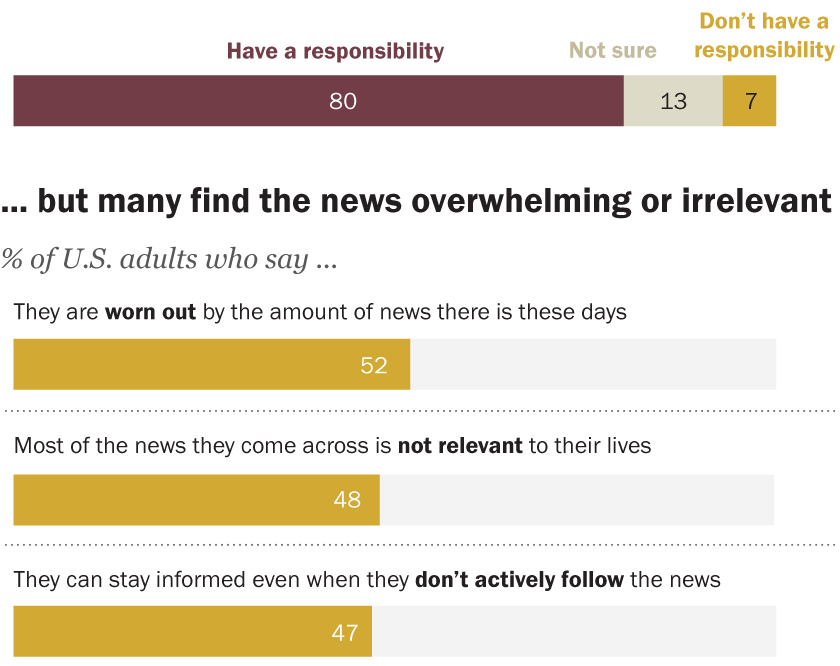
The clearest finding was a widening gap between the value Americans placed on staying informed and their growing dissatisfaction with the experience through which the news reached them. Pew found that 80% of U.S. adults believed Americans had a responsibility to be informed when voting. Yet 52% said they were worn out by the amount of news, 48% said most of the news they encountered was not relevant to their lives, and 60% had reduced their news intake at some point. Only 9% said they followed the news solely because they enjoyed it.Pew Research This dissatisfaction was developing within an increasingly intermediated news environment. Although 55% of U.S. adults get news from social media often or sometimes,Pew Research much of that news was found passively rather than actively: 49% of U.S adults said they mostly get news because they happened to come across it.Pew Research This can be encountered between posts, videos, recommendations, and notifications selected by systems whose objectives and ranking decisions were largely invisible. Read alongside Masoud's account of the attention economy, this painted a picture of a public consuming news through intermediaries optimized for engagement rather than understanding.
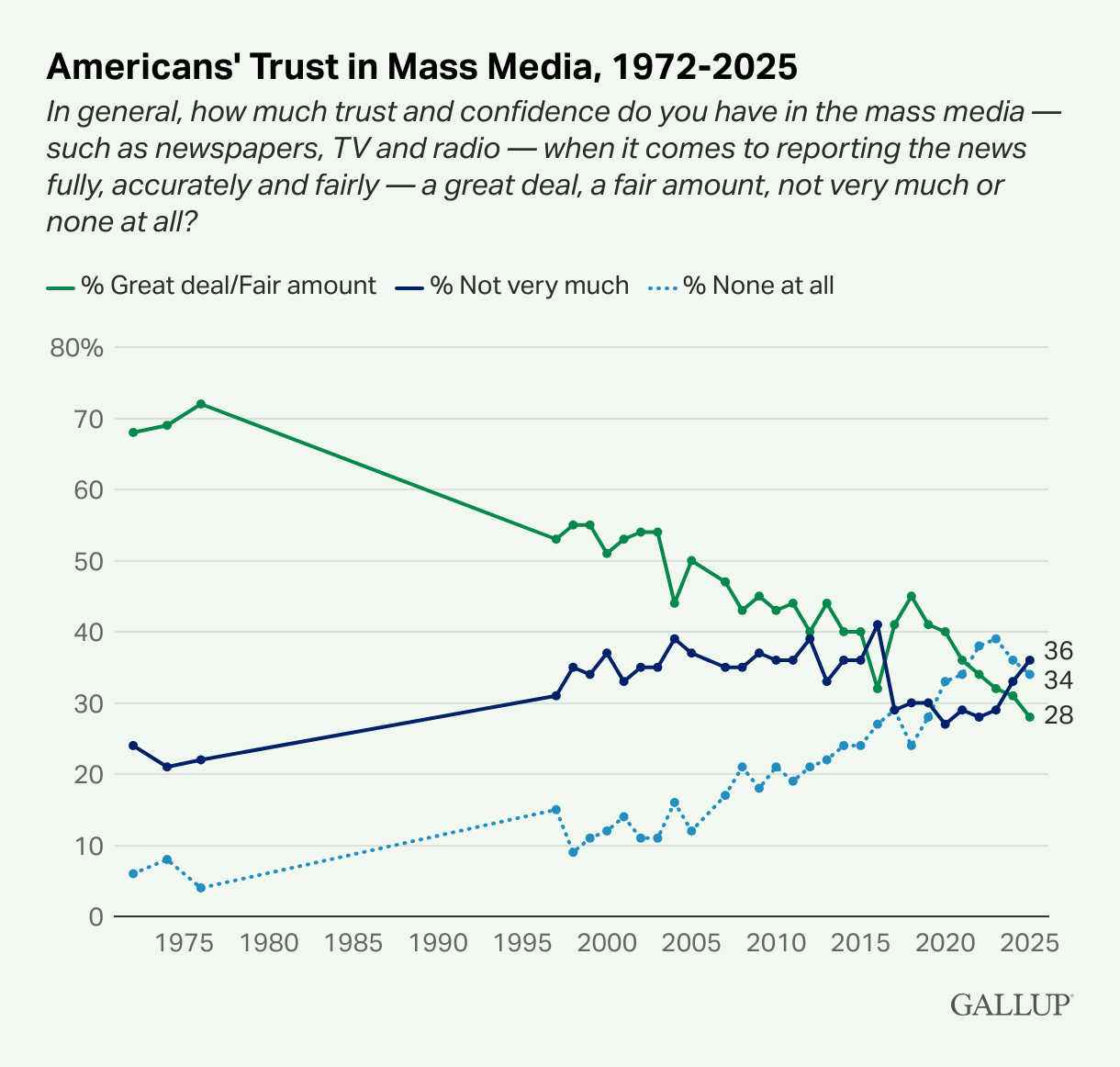
Trust was deteriorating at the same time. According to the Reuters Institute's 2026 Digital News Report, only 25% of Americans said they trusted most news most of the time,Reuters Institute the lowest level recorded in the United States since the organization began tracking the measure in 2015. The same report found that 45% of Americans sometimes or often avoided the news.Reuters Institute Gallup found a similar result through a different measure: only 28% of Americans expressed confidence that mass media would report the news fully, accurately, and fairly, the first time that figure had fallen below 30% in Gallup's more than fifty years of tracking it.Gallup
Despite increasing levels of political polarization, 64% of Americans said it was highly important to get news from multiple sources, 52% said the same about getting news from a range of political perspectives, and 94% believed that people should do their own research to check the accuracy of the news they receive.Pew Research Altogether, these findings suggested that the unmet need was not simply access to more information, but better ways to organize, compare, understand, and control information that was already abundant.
In terms of transparency and agency, in a five-country study that included 1,006 U.S. respondents,SAGE Journals participants expressed a high desire to understand when and why articles were algorithmically recommended, what personal data informed those recommendations, and how they could alter or disable the system. The desire for user control was even slightly stronger than the desire for transparency. This indicated that people did not simply want more relevant recommendations. They wanted greater visibility into and authority over how those recommendations were produced. This preference was not new. Gallup and the Knight Foundation had previously found that 88% of Americans believed major internet companies should publicly disclose the methods used to decide which news items appeared in their feeds.Knight Foundation
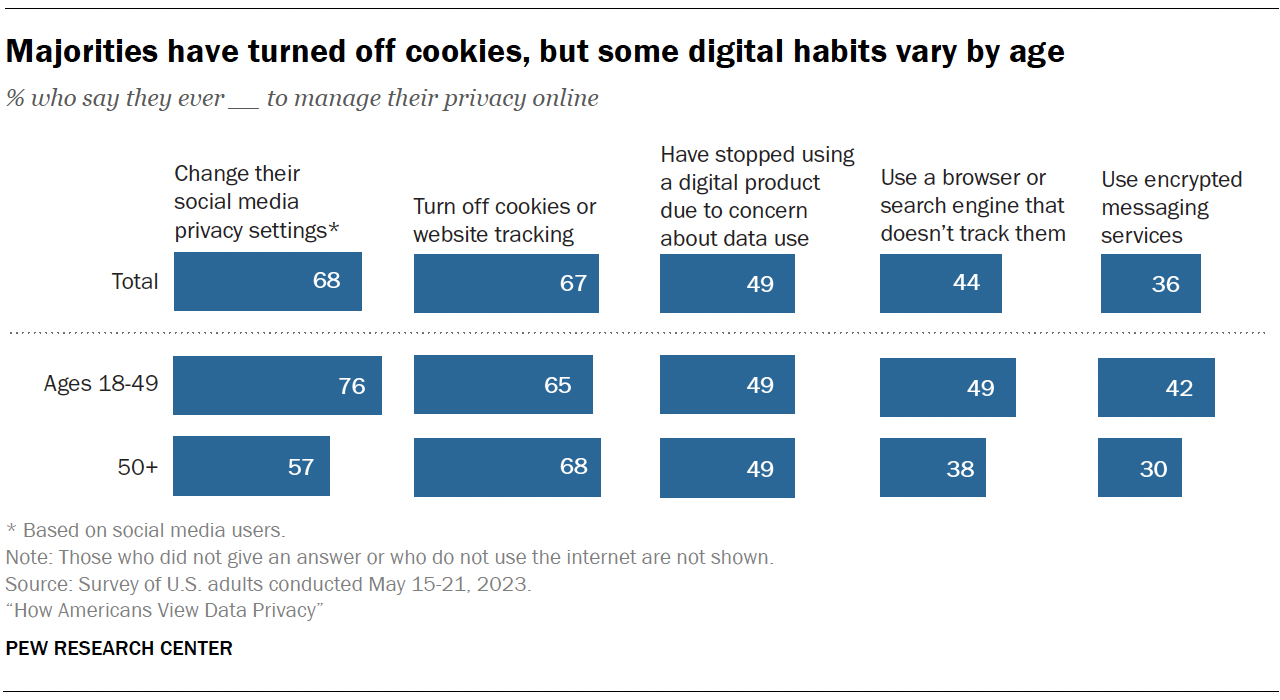
When it comes to privacy, research revealed a similar imbalance between companies and their users. Pew found that 81% of Americans were concerned about how companies used the data collected about them, while 73% felt they had little or no control over that data and 67% had little or no understanding of what companies did with it.Pew Research 49% had stopped using a digital product because of concerns about how their personal information was being used.Pew Research This was particularly relevant to personalized news feeds, which traditionally improve recommendations by observing and retaining behavioral data. A product intended to return agency to the reader could not require that reader to surrender another form of agency in exchange.
Altogether, these findings provided a credible basis for believing that many Americans would value a different relationship with digital news. They wanted to remain informed, but were increasingly dissatisfied with an experience that felt overwhelming, untrustworthy, and outside their control. They valued multiple sources and political perspectives, felt responsible for verifying what they encountered, expressed a desire to understand and influence algorithmic recommendations, and remained deeply concerned about the collection of their personal data. The research helped validate my product hypothesis that there was meaningful interest in a news platform that made its distribution system transparent, gave readers direct control and agency over its behavior and provided tools to inspect the information and sources within it, and did not require them to trade away their privacy in return. The next question was whether any existing news aggregator already delivered that combination of transparency, agency, and privacy.
Competitive Landscape
There is no doubt that the channels through which Americans receive their news are diverse and in no way centralized, whether it is social media, television, podcasts, newsletters, and even AI assistants. Each solved part of the news-discovery problem, but they also forced users to assemble their own fragmented information systems.
Among dedicated news aggregation apps, the main competitors were Apple News, Google News, and Ground News, each providing the clearest reference point towards researching whether any existing news aggregator already delivered that combination of transparency, agency, and privacy.
To make this comparison more concrete, I evaluated each platform through four related questions based on the findings of our market research:
Four questions
Did it make the system distributing and ranking the news visible to the reader?
Did it provide the information necessary to inspect the sources and coverage behind each story?
Did it give readers direct control over that system, rather than simply asking them to provide feedback to an unseen algorithm?
Could it provide personalization without requiring users to surrender the privacy of their reading behavior?
The distinction behind these questions was important. Transparency about a publisher was not necessarily transparency about a feed, and the ability to influence an algorithm was not the same as being able to control it.
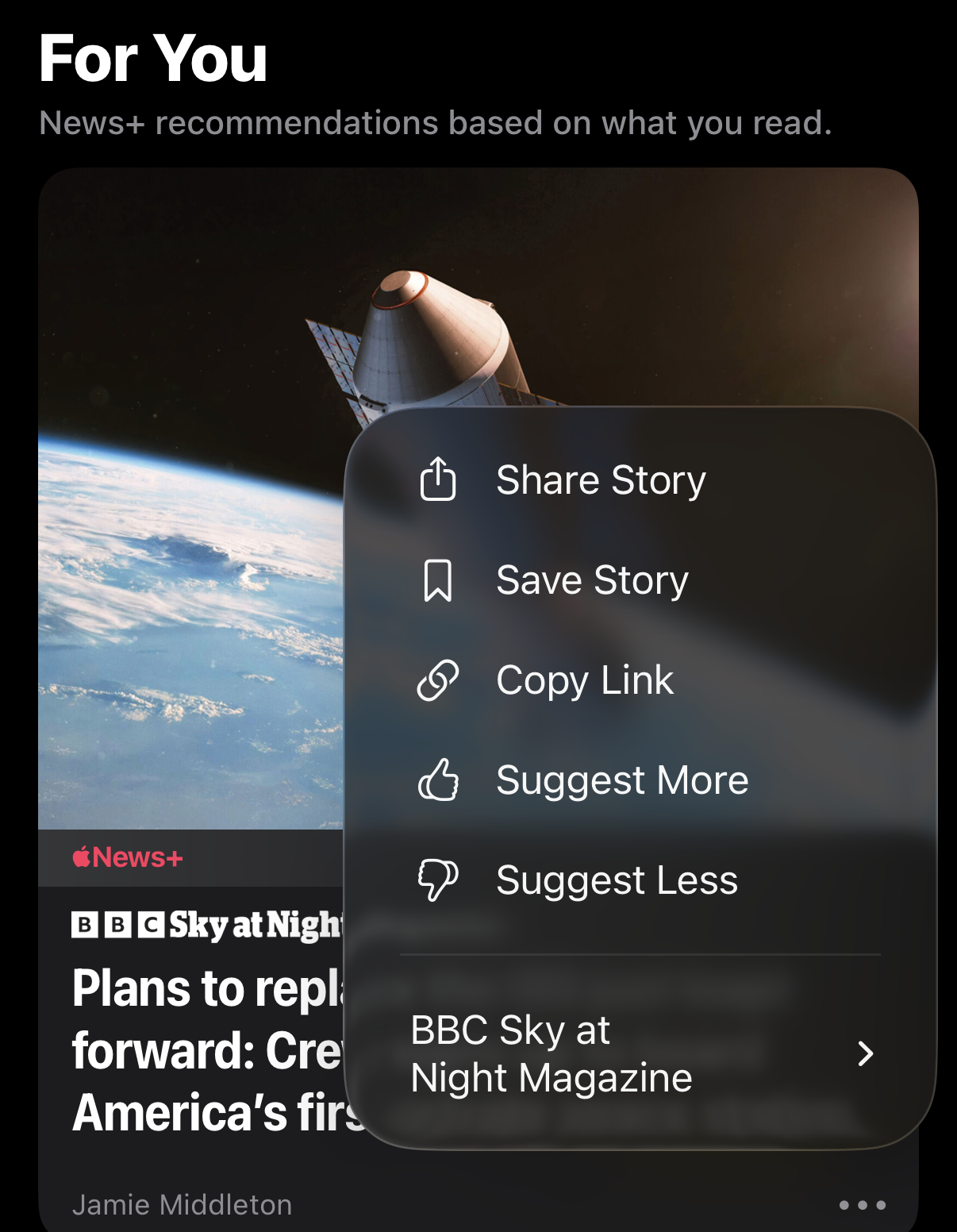
Apple News provided the most polished and editorially curated experience of the three. Its Today feed combined stories selected by Apple News editors with content from followed publications, Siri recommendations, trending stories, and personalized suggestions. Readers could follow or block channels and topics, request more or fewer stories like a particular article, and even restrict the Today feed to publications they explicitly followed. These were meaningful controls, but they remained indirect. Apple did not show why a particular article occupied a particular position, which signals had contributed to that decision, or how those signals were weighted. Users could communicate preferences to the system, but they could not inspect or configure the system itself.Apple Support
Apple came considerably closer to the privacy side of the hypothesis. Recommendations were largely produced using information stored on the device, and Apple associated News activity with an identifier specific to News and Stocks rather than directly with the reader's Apple Account. It also allowed users to clear their recommendation history and reset that identifier. However, the service still collected reading and interaction data, could store reading history through iCloud, and supported advertising that could be personalized using the topics, categories, and publications a person read. Apple News therefore represented a privacy-conscious approach to personalization, but not a system in which behavioral information remained entirely under the reader's control.Apple News and Privacy
Google News approached transparency differently. Google publicly described several broad factors used by its news-ranking systems, including relevance, authoritativeness, freshness, prominence, location, and the reader's interests. Its Full Coverage feature was particularly valuable because it assembled reporting around the same event without personalizing the results. But knowing the general categories of signals did not reveal how those signals interacted in a particular feed. Readers could follow topics and sources, hide publishers, or request more or fewer stories of a certain kind, but they could not see the weight assigned to relevance, freshness, authority, or their own interests. Google provided avenues to influence its algorithm without providing direct authority over it.How News Works on Google Google News Help
Its privacy model also diverged most clearly from the product hypothesis as Google News could personalize recommendations using activity from Google services and YouTube, stored within a Google Account. Google provided substantial controls for viewing, disabling, automatically deleting, or manually deleting this activity, but the personalized experience still depended upon a behavioral profile constructed across a much larger technology ecosystem. The reader retained some control over the data after it had been collected albeit limited.Google Account Help

Ground News was the closest competitor to the opportunity I had identified. It grouped coverage of the same event and surfaced political-bias distributions, factuality and ownership information, headline comparisons, and potential blindspots, validating real demand for source transparency and coverage comparison. However, a deeper teardown revealed that many of the tools needed to act on this information were restricted to paying subscribers. Feed controls, expanded bias and factuality breakdowns, advanced source filters, additional Blindspot coverage, and personal reading insights were distributed across its Pro, Premium, and Vantage plans. Subscriber funding helped Ground News remain independent and ad-free, but placing essential transparency and control mechanisms behind paywalls created tension with its mission.Ground News FAQ Ground News subscriptions
The deeper limitation was that even subscribers could tell Ground what they wanted to see more or less of, but could not see or change the rules used to rank their feed. Meanwhile, its account-based personalization collected viewing history, interactions, preferences, device information, and location data, while its most detailed analysis of that behavior, My News Bias, required a higher subscription tier. Ground News could therefore collect and interpret a reader's behavior while charging that reader for fuller access to the resulting insights. This reproduced a version of the information asymmetry Brin had described, even as the platform sought to challenge it. Its defining features also centered on partisan coverage and political blindspots, delivering its greatest value as a premium analytical toolkit for politically engaged power users rather than an accessible experience for the larger population of news-fatigued readers.Ground News FAQ Ground News subscriptions Ground News source filters Ground News Privacy Policy
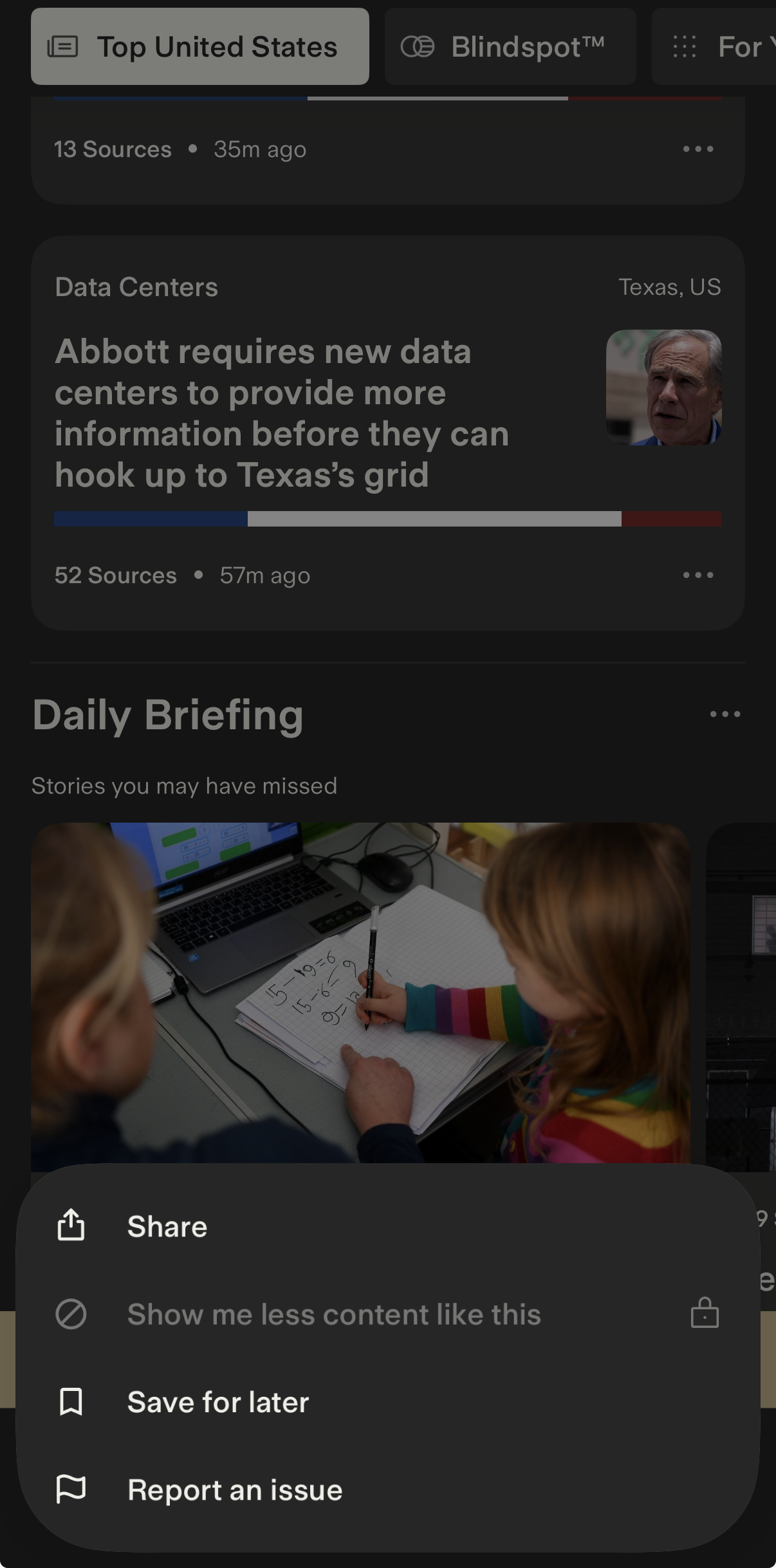
In total, the analysis found that no existing aggregator delivered the complete combination the hypothesis described. Each competitor addressed different parts of transparency, agency, and privacy equation while never fully committing to all of them, each reinforcing the existing information asymmetry within this ecosystem. Apple News was privacy-conscious but opaque, Google News was semi-transparent but not controllable, and Ground News was informationally rich but paywalled and still algorithmically closed. The opportunity, then, was to make transparency, agency, and privacy interconnected properties of the entire system, allowing readers to see why stories appeared, inspect the surrounding sources and coverage, change the signals shaping their feed, and receive personalization without surrendering ownership of their reading behavior. Ultimately, the goal was to create a more reciprocal relationship in which readers could observe, question, and control the platform serving them.
Customer Segmentation
Based on the findings of my initial secondary research, I was able to derive two target customer segments for this solution.
The larger segment was the news-fatigued reader. These readers still valued being informed but felt overwhelmed, distrustful, or poorly served by the existing news experience. Their need was for a calmer and more approachable way to understand what mattered, see the broader context, and exercise control without creating additional work. Applying Pew's finding that 52% of Americans feel worn out by the amount of newsPew Research to the U.S. Census Bureau's estimate of 269.8 million adultsU.S. Census Bureau suggested a total addressable market of roughly 140 million Americans.
The smaller segment was the news power user. These readers actively followed current events, consulted multiple sources, and were more interested in examining political framing, publisher credibility, coverage gaps, and ranking decisions. Although a smaller market, their willingness to try unfamiliar tools made them a likely source of early adopters and detailed product feedback. Based on the Pew Research findings that 9% of Americans say they follow the news just because they enjoy itPew Research puts the total TAM around 24 million Americans.
These were not necessarily two separate audiences, but different levels of engagement with the same underlying need. Both wanted a more understandable and controllable relationship with the news but they differed in how much complexity they were willing to navigate. Any solution would therefore need to make transparency, agency, and privacy approachable for the news-fatigued reader while providing sufficient depth for the power user. If it catered only to power users, it risked remaining a specialized analytical tool whereas if it simplified the experience without exposing meaningful controls, it risked reproducing the same opacity found in existing aggregators. The real opportunity was in bridging the two together.
Chapter Summary
Altogether these findings provided a credible basis for believing that many Americans would value a different relationship with digital news. They wanted to remain informed, but were increasingly dissatisfied with an experience that felt overwhelming, untrustworthy, and outside their control. They valued multiple sources and political perspectives, felt responsible for verifying what they encountered, expressed a desire to understand and influence algorithmic recommendations, and remained deeply concerned about the collection of their personal data. The research helped validate my product hypothesis that there was meaningful interest in a news platform that made its distribution system transparent, gave readers direct control and agency over its behavior and provided tools to inspect the information and sources within it, and did not require them to trade away their privacy in return. The next question was whether any existing news aggregator already delivered that combination of transparency, agency, and privacy.
The competitive analysis found that no existing aggregator delivered the complete combination the hypothesis described. Each competitor addressed different parts of transparency, agency, and privacy equation while never fully committing to all of them, each reinforcing the existing information asymmetry within this ecosystem. Apple News was privacy-conscious but opaque, Google News was semi-transparent but not controllable, and Ground News was informationally rich but paywalled and still algorithmically closed. The opportunity, then, was to make transparency, agency, and privacy interconnected properties of the entire system, allowing readers to see why stories appeared, inspect the surrounding sources and coverage, change the signals shaping their feed, and receive personalization without surrendering ownership of their reading behavior. Ultimately, the goal was to create a more reciprocal relationship in which readers could observe, question, and control the platform serving them.
Finally, I was able to derive two target customer segments for this solution, the “news-fatigued reader” (these readers still valued being informed but felt overwhelmed, distrustful, or poorly served by the existing news experience. Their need was for a calmer and more approachable way to understand what mattered, see the broader context, and exercise control without creating additional work) and the “news power user” (these readers actively followed current events, consulted multiple sources, and were more interested in examining political framing, publisher credibility, coverage gaps, and ranking decisions.)